

Commentary
Alexander Gabuev, Temur Umarov
{
  "authors": [
    "Temur Umarov"
  ],
  "type": "commentary",
  "blog": "Carnegie Politika",
  "centerAffiliationAll": "",
  "centers": [
    "Carnegie Endowment for International Peace",
    "Carnegie Russia Eurasia Center"
  ],
  "collections": [
    "Aso Tavitian Initiative"
  ],
  "englishNewsletterAll": "",
  "nonEnglishNewsletterAll": "",
  "primaryCenter": "Carnegie Russia Eurasia Center",
  "programAffiliation": "",
  "regions": [
    "Central Asia",
    "Kazakhstan",
    "Russia"
  ],
  "topics": [
    "Global Governance",
    "Security",
    "Domestic Politics",
    "Foreign Policy"
  ]
}
Source: Getty
The current U.S. indifference to human rights means Astana no longer has any incentive to refuse extradition requests from its authoritarian neighbors—including Russia.
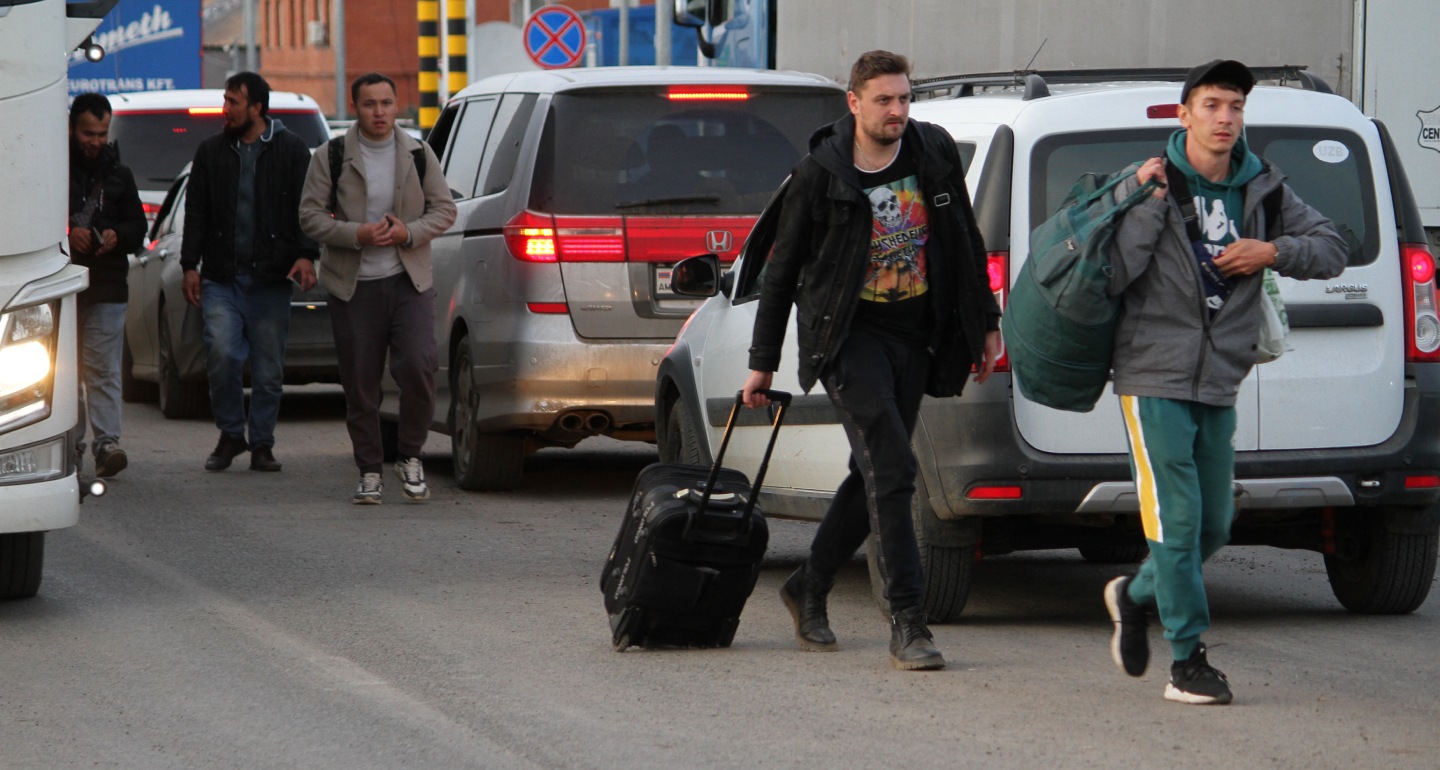
Hundreds of thousands of Russians left for Kazakhstan after Moscow launched its full-scale invasion of Ukraine in 2022 to avoid mobilization, flee political persecution, or simply wait out the wartime upheaval. Most have either since returned home or moved on to Georgia, Turkey, and Europe. But tens of thousands remained, hoping they would be safe from the Russian security forces.
At first, Astana did not extradite Russians being persecuted for political reasons. Until 2026, there were only two known cases of Russians being handed over without formal extradition proceedings: Federal Guard Service officer Mikhail Zhilin (for illegally crossing into Kazakhstan), and contract soldier Karim Kasimov (for desertion).
Recently, however, the Kazakh authorities have drastically changed their approach. They extradited IT specialist Alexander Kachkurkin—accused of treason—to Russia in February 2026, and are preparing to hand over another three Russian nationals, who will all likely end up behind bars.
The U-turn is clearly linked to international political shifts on the importance of human rights and democratization. While the West once urged its partners to grant asylum to activists at risk of political persecution, the return of Donald Trump as U.S. president means the old incentives no longer work, and once persuasive arguments are unconvincing.
Like all authoritarian countries, Kazakhstan does not like vocal political activists—neither its own, nor those from other countries. It does not adhere closely to international refugee obligations, like the 1951 United Nations Refugee Convention, or the related 1967 Protocol. It often even fails to comply with its own law on refugees passed in 2010. Nevertheless, the situation is better than in some neighboring countries. In 2025, there were 336 people in Kazakhstan with official refugee status, compared with 217 in Russia and just five in Uzbekistan.
When the Kazakh authorities are deciding what to do with extradition requests, they are usually guided by two factors: internal and external pressure. If the combined pressure is strong, they will usually decide not to grant the extradition. Notably, Astana rarely hands over those from ethnically related groups, like Chinese Kazakhs or Karakalpaks from Uzbekistan.
The case of Chinese citizen and ethnic Kazakh Sayragul Sawutbay is an illustrative example. In 2018, Sawutbay was detained while illegally crossing into Kazakhstan from China. In court, she spoke about the horrors of Chinese “re-education camps” in Xinjiang, and requested asylum.
When Sawutbay became something of a cause célèbre, Astana decided not to hand her over to Beijing. Instead, she was given a suspended sentence, which meant she was able to emigrate to Sweden. There have been dozens of similar cases involving ethnic Kazakhs, and Astana has even given some of them refugee status.
Astana’s approach when it comes to Karakalpak activists has been similar. After the violent suppression of protests in Karakalpakstan’s capital Nukus in 2022, Uzbekistan demanded the extradition of a dozen Karakalpaks who had fled to Kazakhstan. Initially, Astana detained those men and women—but, following pressure from activists and Western countries, it relented, allowing many to go on to Europe.
Before 2022, Kazakhstan was not of great interest to Russian political refugees. But the war in Ukraine meant more Russians were experiencing political persecution, and the list of countries to which they could flee shrank. Kazakhstan—which allows Russians to enter using only their internal ID rather than international passport—remained accessible, becoming particularly popular for men eligible for mobilization, draft dodgers, and deserters. According to Russian data, Russians entered Kazakhstan 568,000 times in the second quarter of 2022, and 1.25 million times in the third quarter, a partial mobilization having been announced in September that year.
At first, the Kazak government assured these Russians they had nothing to fear. Kazakh President Kassym-Jomart Tokayev called on Kazakhs to “show concern” for the new arrivals, while the Kazakh Interior Ministry stressed that Russian draft-dodgers could not be legally extradited.
In reality, though, not all Russian defectors were safe. According to the Idite Lesom (Get Lost) project that helps Russians evade the draft, Kazakhstan has refused refugee status to at least eleven Russians since the full-scale invasion. And political activists have sometimes been detained at the request of the Russian authorities—although not, until recently, deported.
The deportation of IT specialist Kachkurkin changed everything. At the end of January 2026, he was detained for jaywalking and smoking a hookah indoors, and then quickly deported. Upon landing in Russia, Kachkurkin was immediately arrested on board the plane on treason charges for having sent money to Ukraine.
It’s likely that cases like his will become more frequent. Kazakhstan has already agreed to Russia’s request to extradite Yulia Yemalyanova, a former volunteer at the late opposition leader Alexei Navalny’s St. Petersburg office, and Chechen activist Mansur Movlayev. For the moment, their deportations have been suspended following the intervention of the UN Human Rights Committee. But, ultimately, they look likely to go ahead.
Most Kazakhs are unconcerned about the issue of extraditing Russians—unlike when it comes to ethnic Kazakhs. Foreign pressure to stop them from happening also began to weaken last year. Under Trump, human rights organizations have fewer resources to prevent the deportation of political activists.
In the first years of Russia’s invasion of Ukraine, Astana sought to avoid a conflict with Moscow while distancing itself from the war. Granting asylum to anti-war Russians was part of this balancing act—like Tokayev’s refusal to recognize Russian annexation of Ukrainian territory, and his contact with Ukrainian President Volodymyr Zelensky. Ultimately, this approach allowed Astana to strengthen its ties with Washington: the administration of then president Joe Biden did not demand that Astana break with Moscow, and welcomed “safe” forms of resistance to Russia as a path to greater Central Asian autonomy.
However, Trump is not particularly interested in strengthening democracy—even sometimes seeing it as an obstacle to U.S. interests. As a result, there are now fewer reasons for Astana to risk criticizing the Kremlin. Indeed, Tokayev has begun talking about how Russia cannot be defeated on the battlefield, and Russian President Vladimir Putin’s international role as a “symbol of faith and purpose.”
By refusing to extradite Russian opposition activists in the first years of the war in Ukraine, Kazakhstan built a reputation as the region’s most pro-Western nation. In the Trump era, it has no need for such a reputation.
Not only does protecting political activists no longer earn Astana dividends in the West, it irritates its authoritarian neighbours. Whether or not Kazakhstan rejects Russia’s request for deportation of political activists, there’s no chance Europe in return will ever approve Astana’s own extradition requests for figures like opposition leader Mukhtar Ablyazov, ex-Almaty mayor Viktor Khrapunov, or activist Dina Smailova. Neighboring authoritarian regimes are more likely to return the favor.

Fellow, Carnegie Russia Eurasia Center
Temur Umarov is an expert on China and Central Asia, and a fellow at the Carnegie Russia Eurasia Center.
Recent Work

Alexander Gabuev, Temur Umarov
Temur Umarov
Carnegie does not take institutional positions on public policy issues; the views represented herein are those of the author(s) and do not necessarily reflect the views of Carnegie, its staff, or its trustees.
For the Middle Corridor to fulfill its promises, one of these routes must become scalable. At present, neither is.
Friedrich Conradi

Central Asia’s digital ambitions are achievable, but only if policy is aligned with the region’s physical constraints.

Aruzhan Meirkhanova
Kazakhstan’s new constitution is an embodiment of the ruling elite’s fears and a self-serving attempt to preserve the status quo while they still can.
Serik Beysembaev
Despite its reputation as an island of democracy in Central Asia, Kyrgyzstan appears to be on the brink of becoming a personalist autocracy.
Temur Umarov
Having failed to build a team that he can fully trust or establish strong state institutions, Mirziyoyev has become reliant on his family.

Galiya Ibragimova